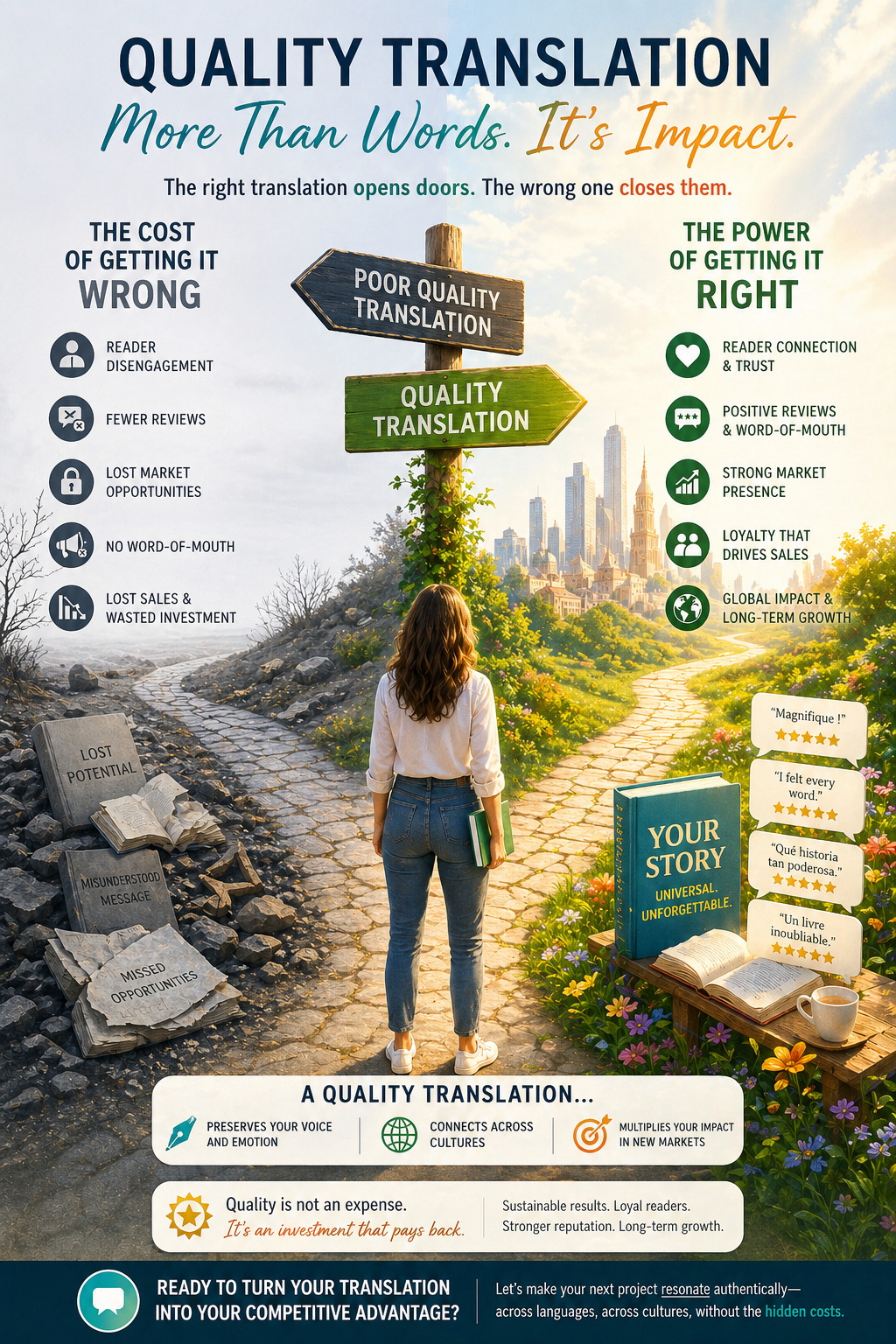
Quality translation is rarely the first thing authors and publishers think about when entering a new market. Most conversations start with price. Clients ask: How much does it cost? But the real question—the one that actually determines your return on investment—is: What’s the cost of getting it wrong?
This distinction matters more than most people realize. And yet, it’s the question that almost never gets asked at the start of a project.
Why Poor Quality Translation Silently Destroys Your Results
A subpar translation might seem like a harmless way to cut costs. After all, the words are there, the meaning is roughly conveyed, and the budget is intact. But the damage is rarely visible on day one.
It shows up gradually—in the reader who doesn’t quite connect with your book, in the reviewer who found the tone “off” without being able to explain why, in the potential buyer who moved on to a competitor whose content simply felt more natural to them.
Here’s the uncomfortable truth: most readers won’t complain about a bad translation. They’ll just quietly disengage, close the book, and never come back. You won’t get a one-star review explaining that the syntax felt unnatural or that the cultural references didn’t land. You’ll just get silence—and silence, in publishing, means lost sales.
A poor quality translation actively erodes:
- Reader trust — When language feels awkward or unnatural, readers disengage. They may not know why, but they feel it immediately.
- Positive reviews — A translated book that doesn’t resonate rarely generates the word-of-mouth that drives organic growth.
- Long-term market presence — First impressions in a new language market are hard to reverse. A weak launch can close doors that take years to reopen.
- Word-of-mouth potential — Readers recommend books that moved them. A translation that flattens emotion or loses nuance simply won’t inspire that kind of enthusiasm.
The most dangerous part? You often don’t see the damage until it’s too late—until the reviews are in, the launch window has closed, and the opportunity has passed.
What a Quality Translation Actually Delivers
Flip the lens, and a high-quality translation becomes one of the most powerful tools in your global publishing strategy.
Think about what a skilled translator actually does. They don’t just convert words from one language to another. They reconstruct the voice, the rhythm, the emotional undertones, and the cultural references that make your work resonate. They make a French reader feel what an English reader felt—without them ever realizing they’re reading a translation. That invisibility is the mark of exceptional craft.
That kind of quality translation builds:
- Credibility with your audience — A fluent, natural translation signals professionalism and genuine respect for the reader’s experience.
- Emotional resonance with your message — Stories land when they feel authentic. Quality translation preserves that authenticity across languages and cultures.
- Loyalty that drives sales — Readers who connect deeply with a translated work will seek out your other titles, recommend you to friends, and leave the reviews that fuel long-term discovery.
In short: a great translation doesn’t just deliver your content—it multiplies its impact across an entirely new market.
The Publishing Parallel: Why Quality Always Wins
This dynamic isn’t unique to translation. It mirrors the broader logic of publishing itself.
Authors who invest in professional editing, thoughtful cover design, and strategic positioning consistently outperform those who cut corners at every step. The market rewards quality—not always because readers can articulate what they’re responding to, but because they feel the difference, even subconsciously.
Quality translation is no different. It is, in many ways, the final layer of editorial craft before your work meets a new audience. It deserves the same level of attention and investment as every other stage of your publishing process.
For further reading on this, the American Translators Association and PEN America’s translation resources offer excellent perspectives on professional standards in literary translation.
Sustainability Over Short-Term Savings
In publishing, as in business, sustainability beats short-term savings every time. A low-cost quality translation that underperforms costs far more in lost revenue, damaged reputation, and wasted marketing spend than the premium you saved upfront.
The calculus is straightforward: invest in quality translation once, and that investment compounds over time. Every reader who connects with your work becomes a potential ambassador for it. Cut corners, and you pay for it repeatedly—in refunds, in weak launches, in markets you never truly broke into.
Ready to Make Quality Translation Your Competitive Advantage?
Your translation should be an asset, not a liability. If you’re ready to stop treating it as a line item and start thinking of it as a strategic lever for global growth, let’s talk. The goal is simple: make your next project resonate authentically—across languages, across cultures, and without the hidden costs.