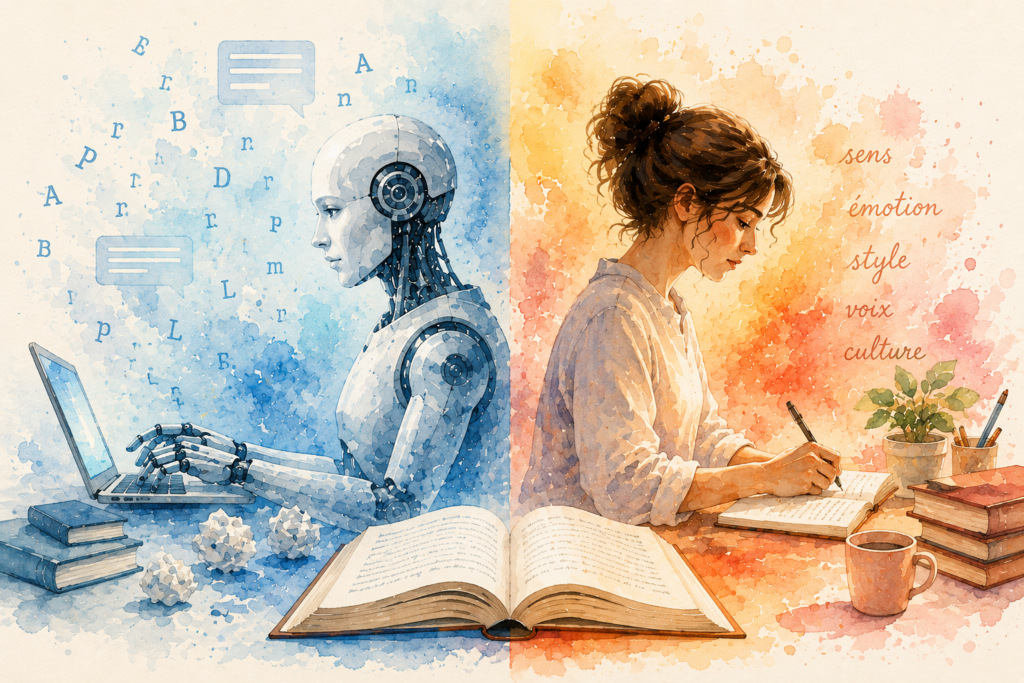
The publishing industry is rushing headlong into AI-assisted translation. The results, for literature at least, are often catastrophic, and the consequences reach far beyond a few awkward sentences. Here’s why AI cannot replace human translators.
A Scandal That Shook the Publishing World
In November 2024, a seemingly innocuous press release sent shockwaves through the literary world. Veen Bosch & Keuning (VBK), the largest publisher in the Netherlands, recently acquired by Simon & Schuster, itself swallowed by the private equity firm Kohlberg Kravis Roberts, announced it would use artificial intelligence to translate a selection of novels into English. The experiment, the publisher hastened to explain, concerned only “commercial fiction”: crime thrillers, romances, fantasy. Fewer than ten titles. Nothing serious.
The reaction was immediate and furious. Translators, authors, and literary organisations across Europe condemned what The Bookseller called a “disastrous decision.” An open letter from the European Council of Literary Translators’ Associations declared: “Books are written by human authors and should be translated by human translators. Imagination, understanding, and creativity are intrinsically human and should not be left out of any literary text.”
But VBK’s move was not an isolated incident. In August 2024, Japanese publishing giant Shogakukan announced a project to AI-translate up to 400 light novels for the North American market within two years. Meanwhile, a 2024 survey by the Society of Authors found that over a third of professional translators had already lost work to generative AI tools. The direction of travel is clear, and deeply troubling.
To understand why, we need to look at what translation of literary fiction actually involves, and at the concrete, sometimes absurd failures AI systems have already produced.
The Seductive Logic of the Machine
Let us be fair. The case for AI translation is not without merit, at least on paper.
A professional human translation of a full novel typically costs between several thousand and takes several weeks, sometimes months. For publishers operating on tight margins, and especially for titles with uncertain commercial prospects, these figures are daunting. AI can produce a rough draft in minutes. For languages with a chronic shortage of qualified literary translators, automated tools can at least open a door to accessibility.
The technology has also genuinely improved. Early machine translation produced output that was obviously mechanical: wooden, literal, often baffling. Modern large language models handle straightforward prose with reasonable competence. For genre fiction heavy on action and dialogue, for web novels and serialised stories where readers prioritise speed over polish, AI has carved out a legitimate niche. Fan translation communities, who have long worked to bring Asian web novels to English-speaking readers, often use AI as a starting point, then layer in cultural notes and stylistic corrections.
And there is an honest conversation to be had about how AI could assist human translators: generating first drafts for revision, maintaining glossaries of character names and recurring terminology, flagging inconsistencies across hundreds of pages. Used as a tool rather than a replacement, AI has something to offer.
The problem arises when publishers treat AI not as an assistant but as a substitute, and when they apply it to the complex, voice-driven, culturally dense world of literary fiction.
When the Machine Breaks Down: A Catalogue of Failures
The Meaning That Gets Lost
The most obvious failures are semantic. AI translation systems, however sophisticated, are fundamentally statistical: they predict the most likely word or phrase to follow a given sequence, based on patterns learned from their training data. They do not understand what they are translating. They do not know that “bike” in a thriller set in the 1970s refers to a motorcycle, not a bicycle. And so a character who “jumped on his bike and tore off down the highway” arrives in the French edition pedalling furiously on a vélo, to the bafflement of readers.
This kind of error, swapping a motorcycle for a bicycle, reversing a sentence’s meaning, translating a name that should have been left intact, falls into what professional linguists call “catastrophic errors”: failures that do not merely sound clumsy but actively mislead. The AI does not understand context. It cannot tell the difference between “bank” meaning a financial institution and “bank” meaning a river’s edge. It cannot grasp that a character who says “I could kill for a coffee right now” is expressing desire, not threat.
Cultural references fare even worse. An idiom, a proverb, a joke built on wordplay in the source language simply does not map onto an equivalent in the target language. A skilled human translator will find a way, a different idiom that carries the same weight, a restructured joke that lands in the new cultural context. The AI will translate the words literally and produce something that baffles, confuses, or offends.
The Particular Nightmare of French
For French specifically, AI translation faces a set of structural challenges that expose the technology’s limitations with remarkable clarity.
Typography and dialogue formatting. French and English handle dialogue completely differently. In English, speech is enclosed in quotation marks (“Hello,” she said). In France, the vast majority of published novels use the em-dash (—) to introduce each new line of speech, placed at the start of a new line followed by a space. French guillemets (« … ») may frame the opening and closing of a dialogue scene in traditional typography, but in contemporary French publishing they are frequently dropped entirely in favour of the em-dash alone from the first line, a convention now dominant across most French publishers.
AI systems trained primarily on English-language data consistently get this wrong. They reproduce the English convention, inserting straight quotation marks (“like this”) rather than the em-dash. When they do attempt a dash, they confuse the em-dash (—) with a simple hyphen (-) or an en-dash (–), and omit the required space that follows. The result, to any French reader or editor, immediately signals an unrevised, unprofessional text, the typographic equivalent of a spelling mistake on every page. The irony is sharp: Wikipedia now notes that the em-dash « is very frequently used by generative AI, to the point of becoming a characteristic feature of AI-produced texts » and is sometimes called the « ChatGPT dash », not because AI has mastered French dialogue convention, but because it deploys the em-dash indiscriminately in running prose where it has no business appearing.
Tu or vous? French makes a grammatical distinction that English abandoned centuries ago: the choice between the informal tu and the formal vous when addressing a single person. This choice is not merely a question of politeness; it encodes the entire social and emotional relationship between characters. A detective who vouvoies a suspect and then, in a moment of contempt or intimacy, switches to tutoiement, that shift carries narrative weight. Two lovers who begin with the formal vous and gradually migrate to tu are enacting their growing closeness in the very structure of their sentences.
AI systems handle this dismally. They will assign tu or vous more or less arbitrarily, then fail to maintain consistency: a character addressed as vous on page 12 may be tu on page 87 for no discernible reason… on in the next sentence. Worse, the system has no way of grasping the emotional significance of a switch. The result is not merely grammatically inconsistent but narratively incoherent, relationships appear to shift at random, for no reason the reader can perceive.
Tenses and the literary past. French narrative prose uses a system of past tenses radically different from English. The passé simple, a tense that barely exists in spoken French and is essentially confined to written, formal, and literary registers, is the backbone of classical and contemporary French fiction. It conveys completed actions in a narrative past. Working alongside it, the imparfait describes ongoing states, habitual actions, and background atmosphere. Together, they create a layered texture of time that skilled French authors deploy with great intentionality.
English has no direct equivalent. And AI, when translating from English into French, must decide, from context alone, with no genuine comprehension, which tense to use. It tends to default to the passé composé, the conversational past tense, which is technically correct but registers as flat, informal, and tonally wrong for literary fiction. Or it mixes tenses incoherently, producing passages where the narrative voice lurches between registers in ways no human author would ever choose.
Gendered agreement and grammatical coherence. French grammar requires agreement in gender and number across adjectives, past participles, and pronouns. This is complex enough in normal writing; in fiction, it extends to narrative choices about how characters are described, how objects are gendered, how ambiguity of identity is maintained or revealed. AI systems make errors here constantly, and those errors, scattered through hundreds of pages, accumulate into a text that reads as careless and unrevised.
The Voice That Vanishes
Beyond these technical failures lies a deeper problem: AI translation erases the author’s voice.
Every writer has a rhythm, a syntax, a repertoire of verbal habits that constitute their identity on the page. The short, declarative sentences of Hemingway. The looping, clause-heavy sentences of Proust. The flat affect of a Scandinavian crime writer deployed to disturbing effect. These features are not decorations; they are the text. A translation that smooths them out, that levels everything to a competent, readable average, has produced something technically functional and artistically hollow.
AI systems, trained to produce fluent, grammatically correct output, are precisely calibrated to produce this kind of smoothness. They flatten. They average. They are, by design, allergic to the eccentric, the idiosyncratic, the deliberately awkward, all the things that make a literary voice distinctive and memorable. As one bilingual reader put it memorably: « AI translations feel like sprinting through a museum, you see the highlights but miss the brushstrokes. »
Dialects and sociolects, the specific speech patterns of characters defined by class, region, age, or education, present similar problems. A character who speaks in broad Yorkshire dialect, or in the clipped cadences of French verlan, or in the formal register of a nineteenth-century aristocrat: these voices require a translator who understands not just two languages but two cultures, and who has the creative skill to find equivalents that carry the same social and emotional charge. An AI has no such understanding. It normalises.
The Hallucination Problem
There is one failure mode particular to large language models that deserves special mention: hallucination. These systems, when they lack data or cannot determine the correct output, do not say “I don’t know.” They invent. They generate plausible-sounding text that may bear little relationship to the source.
In 2024, the Société française des traducteurs highlighted this risk explicitly, noting that generative AI « prefers to hallucinate when it lacks data, rather than remain mute. » In a legal or technical context, hallucination produces wrong information. In a literary context, it produces wrong sentences, sentences the author never wrote, scenes subtly altered, meanings reversed. A translator who hallucinates is not translating; they are rewriting. And they are doing so invisibly, without attribution, without accountability.
What the Research Says
The evidence is not merely anecdotal. An October 2024 paper from the Natural Language Learning and Generation Lab at the University of Aberdeen concluded that literary translation remains “an exclusive domain of human translators.” The stylistic, emotional, and cultural complexity of literary fiction lies, for now, beyond what AI can reliably reproduce.
The economic picture reinforces this. Louise Rogers Lalaurie, who has translated fifteen novels from French, has noted that post-editing an AI translation, going through it line by line to correct errors, inconsistencies, and infelicities, can end up costing more than a competent human translation from the start. « The unpublishable, frequently incomprehensible AI translation, » she recounted of one experience, « added about three weeks and at least a couple of thousand euros to the process. »
Publishers who believe they are saving money may find they are simply redistributing costs, while degrading quality and demoralising the professionals who do the actual work of repair.
The Hybrid Model: Fair Compromise or Dressed-Up Exploitation?
Proponents of AI translation often invoke the “hybrid model”: AI generates a first draft, a human translator revises and polishes. This sounds reasonable. For those who do it day in, day out, the reality is something else entirely.
What advocates of the hybrid model delicately call « post-editing » looks in practice like a disguised retranslation. AI-generated sentences are frequently awkward, convoluted, or simply meaningless. Some passages flatly contradict the original, not through interpretive nuance but through outright error, the meaning reversed. Words are left untranslated, stranded in the source language like islands of abandonment in the middle of the text. The AI invents verbs that do not exist, forges grammatical constructions that correspond to no actual usage. And sometimes, more troublingly still, entire sentences simply vanish, omitted without explanation, as if swallowed by the machine.
The result? A professional translator hired to « correct » an AI draft ends up retranslating roughly 80% of the text. And they have no choice but to keep their eyes fixed permanently on the original, confronting every sentence against the source, hunting down betrayals and absences. This is no longer revision, it is a full translation, carried out under the same conditions as any ordinary translation job, but paid at the rate of a light proofread.
This is the economic trap at the heart of the hybrid model. Publishers who use it pay less, gambling that the translator will settle for a quick pass. But a professional translator who cares about their work cannot bring themselves to deliver something mediocre. Their professional conscience demands quality: the French reader must have the same reading experience as the first readers of the original. And so the translator corrects, rewrites, refines, investing considerable time, for a fee that bears no relation to the actual scope of the work performed.
The hybrid model does not therefore reduce human labour: it precarises it. It displaces the translator’s value without eliminating it, while creating the conditions for a silent exploitation. And it insidiously degrades the profession: by treating translation as a form of mechanical correction, it discourages vocations, erodes expertise, and prepares the ground for a normalisation of the mediocre.
There is also the distinction, increasingly invoked to justify AI use, between « commercial fiction » and « literary fiction. » VBK made this distinction explicitly: AI for thrillers and romances, humans for the serious stuff. But, as translator and International Booker Prize winner Michele Hutchison pointed out, this implies that commercial fiction « is purely formulaic and doesn’t contain many creative elements », which is an insult to authors and readers alike. A well-crafted thriller, a witty romance, a thoughtfully constructed fantasy: these are not lesser works. They deserve the same care in translation.
Conclusion: Translation Is an Act of Creation, and AI cannot replace human translators
The debate around AI and literary translation is, at its core, a debate about what literature is for.
If a novel is a vehicle for plot, a sequence of events to be transferred from one language to another as efficiently as possible, then AI translation, with some post-editing, might be considered adequate. But if a novel is a work of art, a crafted object in which every sentence, every rhythm, every word choice carries meaning, then translation is not a transfer but a recreation. The translator is not a conduit; they are a co-author, working in the shadow of the original to produce something that lives fully in a new language and culture.
No algorithm, however sophisticated, can do this. Not because AI lacks processing power, but because it lacks everything that makes language human: the lived experience of culture, the emotional intelligence to grasp irony and intimacy, the aesthetic judgement to know when a sentence is right.
Readers deserve to know when the book they are holding was translated by a machine. Publishers, authors, and legislators should work toward transparency standards that make this clear. And the literary community should continue to insist, loudly, that the translation of fiction is a creative act, one that cannot be automated without loss.
Something always gets lost in translation. With AI, the losses are too great to ignore.
→ View my services and request a quote
Sources: Society of Authors, “SoA survey reveals a third of translators and quarter of illustrators losing work to AI” (11 April 2024); The Guardian, “Dutch publisher to use AI to translate ‘limited number of books’ into English” (4 November 2024); The Guardian, “‘It gets more and more confused’: can AI replace translators?” (11 November 2024); The Bookseller (November 2024); World Literature Today (2025); GlobalData / Verdict (2025).