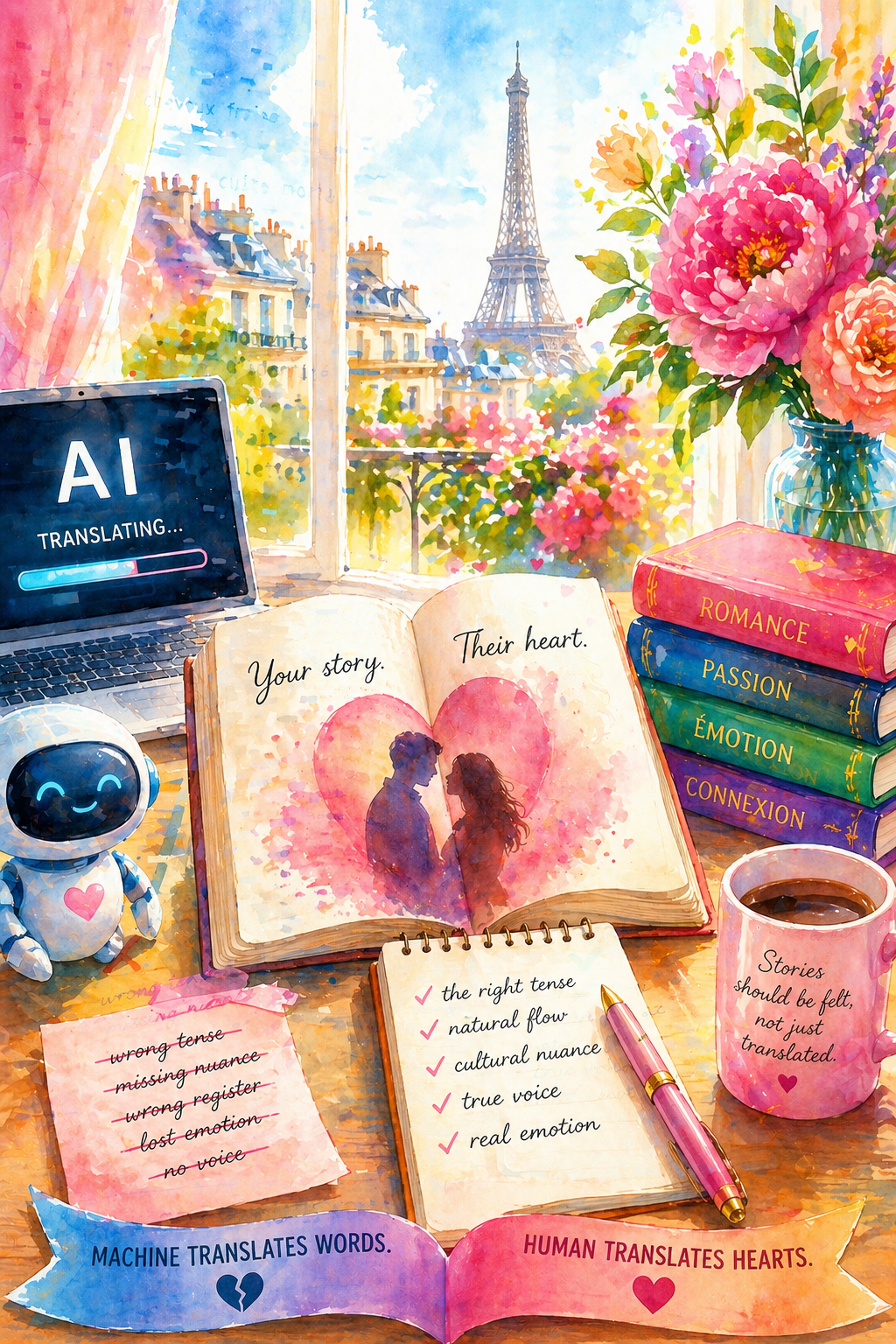
You’ve spent months — sometimes years — writing your romance novel. You’ve revised, polished, and finally published it in English. Now you’re ready to reach French readers, and AI translation tools seem like the obvious solution: fast, affordable, and surprisingly fluent on the surface.
But here’s what no one tells you before you hit “translate”: fluent isn’t the same as right. And in romance fiction, wrong can quietly destroy everything you’ve worked for.
I’ve corrected AI-translated romance novels. What I’ve found isn’t a few typos. It’s structural, cultural, and linguistic failure — the kind that French readers notice immediately, even if they can’t always articulate why. The kind that earns two-star reviews that say “the story was good, but the translation ruined it.”
Let me show you what I mean.
The Tense Problem Nobody Warned You About
This is the single most common — and most damaging — issue I see in AI-translated fiction.
In English, past tense storytelling is fairly forgiving. French is not. Literary French has a specific tense for narrative prose — the passé simple — that signals to readers: this is a story, you’re in safe hands. AI tools almost universally default to the passé composé instead, which is the tense you use when texting a friend to say you just had lunch.
The result? French readers describe it as reading a recipe. Heavy, mechanical, exhausting. I’ve seen readers abandon an entire series — and send the books back to Kindle — because the tense choice made the prose unbearable, even when they loved the story.
One entire book I reviewed opened every single sentence in the passé composé. The author had no idea. The tool had delivered something that looked like French. It was not readable French fiction.
The Dialogue Formatting Crisis
French dialogue doesn’t use quotation marks. It uses an em dash (—) at the start of each spoken line, with specific typographical rules about how narration and dialogue interact — a system called l’incise.
AI tools consistently fail this. What I see most often is dialogue and narration mashed into the same paragraph with no visual separation, making it impossible to tell who is speaking or when a character has stopped talking. In one manuscript I reviewed, an entire page of alternating dialogue and narration was formatted as a single block of text.
French readers are trained from childhood to read dialogue formatted with dashes. Give them quotation marks, or worse, no punctuation at all, and they feel displaced — like they’re reading a draft, not a finished book.
The tu/vous Problem (And Why It’s Untranslatable by Machine)
English has one word for “you.” French has two, and the choice between them is everything.
Tu is intimate, informal, equal. Vous is respectful, distanced, hierarchical. The shift from one to the other — or the refusal to shift — carries enormous emotional weight in French fiction. A character who addresses their love interest as vous when everyone else uses tu is saying something profound about distance and desire. A boss who suddenly uses tu to an employee is crossing a line.
AI tools have no idea. They pick one form and apply it inconsistently, or they switch mid-scene for no apparent reason. In several manuscripts I’ve reviewed, a character starts a conversation with tu and ends it with vous — not as a literary choice, but as a malfunction. In a romance, where the emotional register between characters is everything, this is devastating.
When Words Simply Don’t Exist
AI translation is built on pattern recognition. Give it a word it doesn’t recognize in context, and it will produce something that looks plausible but means nothing — or something absurd.
“Strawberry hair” became cheveux fraise in one translation I reviewed. In French, this is not a color. It sounds like someone described a character’s hair as smelling of jam.
“She was dead drunk” became cuite morte in another — a phrase that does not exist in French. Neither does moments d’identité for “identity moments,” or souhait de paillettes for “glitter wish.” These are calques — direct word-for-word transfers that French readers recognize immediately as machine output.
The issue isn’t just aesthetics. When a character in a biker romance has their motorcycle translated as vélo — a bicycle — the entire atmosphere collapses. The reader is no longer in a biker club. They’re at the Tour de France.
The Register Problem: When Your Voice Disappears
Every romance author has a voice. Regency authors in particular craft a very specific register — formal but warm, witty but restrained. AI cannot hold that register across a full manuscript.
What I see instead is jarring inconsistency: a sentence of elegant, period-appropriate prose followed by a line that reads like a modern text message. Or the reverse — a character with a deliberately casual voice suddenly using archaic constructions (Lorsqu’il te l’octroie instead of quand il te le donne) because the AI reached for the most literal French equivalent rather than the right one.
Voice is the hardest thing to preserve in translation. It requires judgment — knowing when “damn proud” should become fichtrement fière and when that word choice would jar a French reader right out of the story. AI doesn’t make that judgment. It makes a guess.
What This Means For Your Book
None of this means AI translation is worthless. It can produce a functional first draft. What it cannot do is deliver a manuscript that French readers will experience the way your English readers experienced it — as a story they couldn’t put down, with characters who felt real and a voice that pulled them through.
The reviews are already out there. French readers are noticing. They leave reviews that mention “mauvaise traduction,” tense errors, words that don’t exist, characters whose gender shifts mid-book because the AI lost track of pronouns. These are not minor complaints. They affect sales, series performance, and your reputation in a market you’ve worked hard to enter.
If you’ve already used an AI tool and you’re not sure what you have, I offer a sample review — I’ll read the first chapter and tell you honestly what’s there. If you’re planning a translation and want it done right from the start, let’s talk.
I also offer proofreading and copy-editing in French — whether your manuscript was translated by AI, by another translator, or written directly in French. Sometimes a book just needs a careful second pair of eyes before it reaches readers.
Your story deserves to sound like yours. In any language.
Sophie — Élan & Co | Literary Translator EN→FR | sophie@elanandco.fr