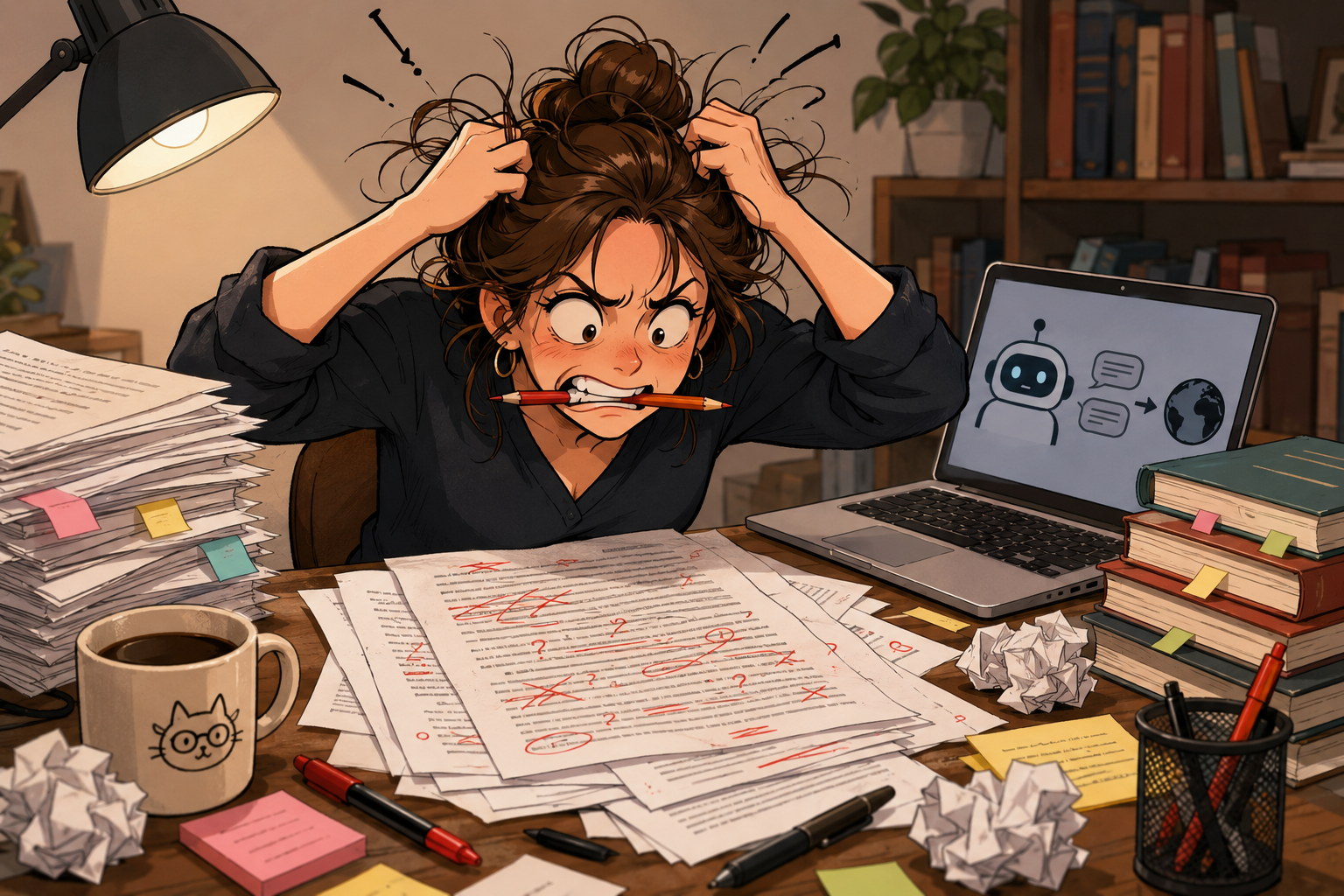
AI translation of French novel manuscripts is becoming increasingly common. And after reviewing dozens of them, I can tell you exactly what gets lost.
A few months ago, I opened a manuscript. Adventure novel, American biker club, tough and weathered characters, endless open roads, tension simmering under every line of dialogue. It had all the makings of a great read.
Except in the French version, the heroes were riding bicycles.
The AI had translated bike as vélo, the everyday French word for bicycle. One algorithmic decision, and the entire atmosphere of the book had collapsed. It wasn’t a biker novel anymore. It was the Tour de France.
This would be funny if it were a one-off. But after reviewing dozens of AI-translated manuscripts, I can tell you: it isn’t. It’s a symptom.
The problem isn’t grammar. It’s judgment.
AI translation tools are improving fast. They now produce texts that look correct at first glance, and that’s precisely what makes them dangerous for literary fiction. French readers won’t stop to identify a grammar rule. They’ll just feel that something is off, put the book down, and move on. And you, the author, will never know why.
Literary translation isn’t about correctness. It’s about choices, hundreds of them per page. And that’s exactly where AI consistently falls short.
Here are the four areas where the errors are most damaging, the ones I find in almost every AI-translated manuscript I work on.
1. Tu vs. vous: a distinction that shapes every relationship in your novel
French has two words for “you”: tu (informal, intimate) and vous (formal, respectful). Every single line of dialogue requires a choice between them, and that choice carries enormous weight.
Tu signals closeness, equality, familiarity. Vous signals distance, hierarchy, or respect. But the reality in literary fiction is far more nuanced. A character who addresses a stranger with tu might be showing contempt, or deliberately breaking social norms. Two lovers who still use vous with each other weeks into a relationship are telling the reader something about their dynamic that no amount of description could convey as efficiently.
AI doesn’t handle this. It picks a form, applies it, then drifts to the other with no narrative reason. I’ve corrected manuscripts where a character opens a scene addressing someone as tu and closes the same scene using vous, not for dramatic effect, but because the algorithm lost track. For French readers, this is a quiet but persistent rupture in the text, one they can’t quite name, but one that erodes their trust in the book.
2. French dialogue formatting: not a style choice, a convention
French dialogue doesn’t use quotation marks the way English does. Instead, it uses an em dash (—) at the start of each line of speech, combined with a specific system of narrative tags woven into the exchange. This isn’t optional or stylistic: it’s the standard your French readers will expect.
Correctly formatted French dialogue looks like this:
Ellie referma la porte derrière elle.
— Tu étais où ? lui demanda Suzi depuis le couloir.
— Sur le pont. Je n’arrivais pas à dormir.
— Il t’a parlé ?
Elle s’arrêta.
— À peine.
What I typically receive from AI-translated manuscripts looks like this:
Ellie referma la porte derrière elle. — Tu étais où ? lui demanda Suzi depuis le couloir. — Sur le pont. Je n’arrivais pas à dormir. — Il t’a parlé ? Elle s’arrêta. — À peine.
Narration and dialogue collapsed into a single block, with no visual breathing room. This isn’t a cosmetic issue. It’s the difference between a text that reads naturally and one that makes your reader work to figure out who’s speaking. When a manuscript runs to a hundred thousand words formatted this way, fixing it means going through every single page.
3. Past tenses: the single most common AI error in French fiction
This one appears in nearly every manuscript I review, and it does the most damage with readers.
French literary prose uses the passé simple, a tense that exists almost exclusively in written narrative: Il entra dans la pièce. Elle se retourna. Leurs regards se croisèrent. It gives the text flow, momentum, and a distinctly literary quality that French readers expect and respond to.
AI translation almost always produces the passé composé instead: Il est entré dans la pièce. Elle s’est retournée. This is the tense of everyday speech, text messages, and oral storytelling. In prose, it feels laboured, stop-start, and strangely flat.
One reader told me the book felt like reading a recipe. She returned the entire series. This isn’t about grammatical purism. It’s about reading experience. A novel that doesn’t flow is a novel that doesn’t get recommended, and doesn’t sell a second volume.
4. Expressions that don’t exist in French
AI translation is built on pattern recognition. Give it an idiom or a culturally specific phrase it can’t properly contextualise, and it will produce something that looks like French but lands wrong.
A few examples from manuscripts I’ve worked on recently:
- “Souhait de paillettes” for glitter wish, a literal word-for-word transfer that means nothing in French. Readers stumble on it and lose the thread.
- “Moments d’identité” for identity moments, equally meaningless. A French author would write moments rien qu’à nous or moments privilégiés.
- “Cuite morte” for dead drunk, a literal translation that doesn’t exist. The natural French is ivre morte or complètement schlass.
- “Fit claquer sa langue depuis sa place” for tsked from her seat, a construction no French speaker would use. You’d say poussa un soupir agacé or fit claquer sa langue d’un air réprobateur.
French readers notice these. They mention them in reviews. And they attribute them to the author, because your name is on the cover, not the algorithm’s.
What this means for your manuscript
If you’ve used AI to translate your novel into French, what you have is likely a workable first draft, but not a publishable one. The gap between the two is exactly where a human translator or editor comes in: someone who knows how French literary fiction sounds, how dialogue is formatted, which tenses carry which weight, and how to make your story feel written in French rather than converted into it.
These aren’t cosmetic fixes. They determine whether your book gets read to the end, or quietly set aside after chapter one.
If you’d like an honest assessment of where your manuscript stands, I offer a free review of your first chapter. I’ll tell you what’s working, what’s catching, and what needs attention before you publish.
This article is also available in French for your francophone readers and colleagues : [Ce que je corrige chaque semaine dans les romans traduits par IA].
Sophie, Élan & Co | EN→FR Literary Translator and Editor
sophie@elanandco.fr | elanandco.eu